
The Eccentric University Professor is Dead
What Happens When Universities Silence Their Wild Cards

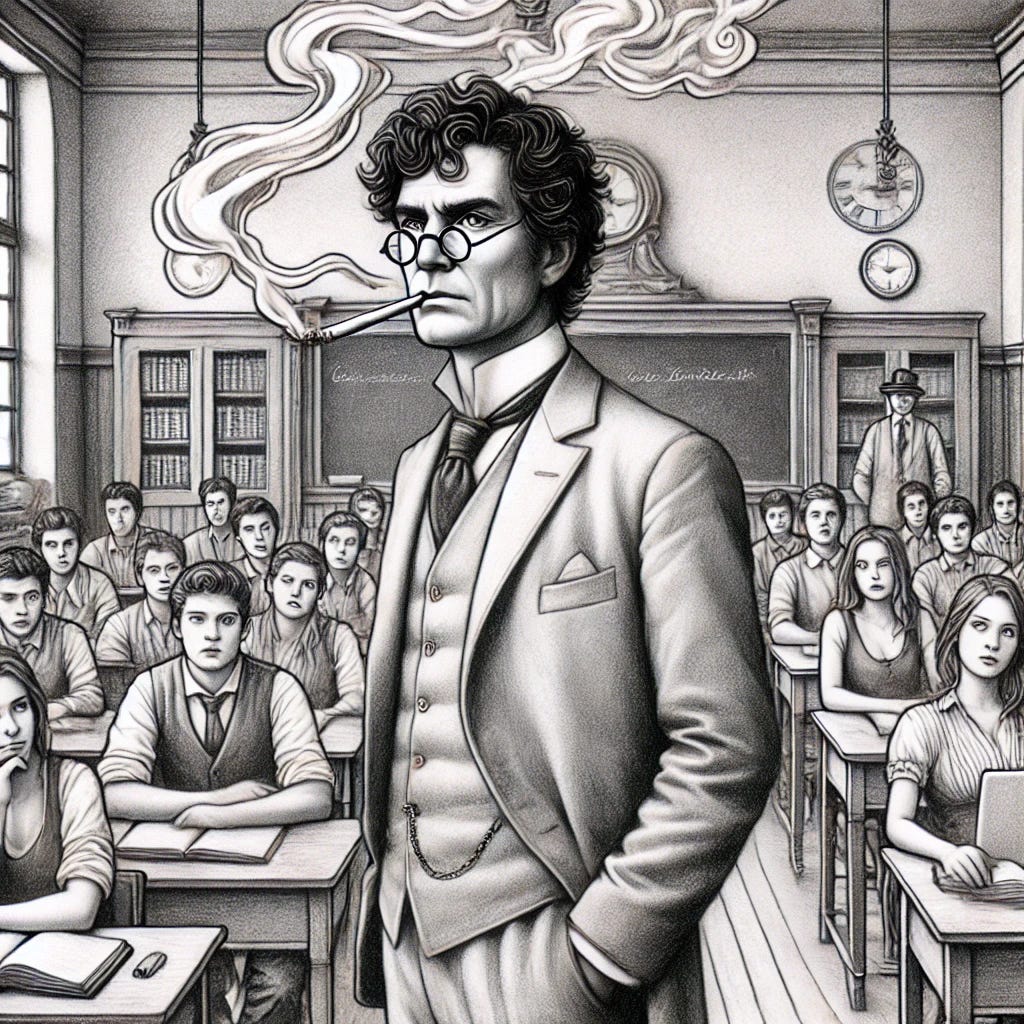
I remember walking into my first history class as a college freshman, a quiet nervousness settling in, my stomach uneasy but not in full revolt. It wasn't hope or excitement—it was more of a dread from not knowing what to expect or if I belonged. The lecture hall was sterile, lit with those dull fluorescent lights that seemed determined to highlight every insecurity, and the chairs were designed more for discomfort than learning.
And then he walked in. His Florsheim wingtip shoes clicked across the wood floor. His face was stoic and stern, the kind that rarely cracked a smile. His dark, penetrating eyes had a way of locking onto you, cutting through the classroom chatter like a laser, making you sit a little straighter, even if you weren't sure why. He was a stodgy professor who looked like he'd seen generations of students shuffle through, each one more clueless than the last.
This was back when smoking indoors was on its way out, but traces of it still lingered. The old man stood momentarily, surveying us like a general sizing up new recruits. He didn't bother with introductions or the usual opening spiel. Instead, he reached into his coat pocket. He pulled out a pack of cigarettes and a classic Zippo lighter that had probably been around as long as he had. Without a word, he lit up, took a long, slow, deliberate drag, and exhaled with the kind of defiance.
"The powers that be say I can't smoke in this building anymore," he said, with a tinge of some accent I didn’t recognize carrying a mixture of gravel and bemusement. He took another long drag, smoke curling lazily around his head, and then, just like that, he launched into the day's lecture.
It was the most badass thing I had witnessed in my young, sheltered life. That moment still stays with me, not as some shadow from the past, but as a happy memory of a bygone era—when university professors could speak their minds without fear, and a classroom felt like a space for raw, unfiltered truth instead of scripted compliance. It was a different world then, one that keeps slipping further into memory, and with each passing year, the weight of that loss feels just a bit heavier.
The Quiet Lessons in Defiance
It matters. University isn't just about memorizing dates or learning to structure an essay correctly. It's about shaping minds. And shaping a mind—really shaping it—means teaching it to question the status quo. To stand firm when the world insists you fold.
Seeing that old professor light up a cigarette was a quiet middle finger of defiance. Did the world change? No. But it was an unspoken challenge to be my own person. It showed me, a nervous freshman, that sometimes it's OK to stare authority in the face and say, 'Not today.'
Maybe it sounds small—silly, even. But those moments stick. They carve an impression into the psyche of young adults trying to figure out life. And when the world demands compliance, we remember. The eccentric professor taught us that we don't always have to play by the rules—especially when the rules are made to keep us docile.
Now? The classrooms are sanitized, the lectures are safe, and the professors tread carefully, compliantly, and cautiously like shepherds guiding flocks through curated pastures. We have lost the eccentrics in academia—the ones who made us squirm and think and taught us to want to rebel a little, too. Indeed, eccentrics still exist. Just don't look for them in the university.
We need the eccentric professor. We need intellectual wild cards, the risk-takers who remind us that courage isn't a relic of the past. We need people who show us that independence is still worth fighting for. Because standing up for something—even something as small as a smoke in a lecture hall—plants seeds in the minds of the impressionable. And those seeds, if we're lucky, might grow into something fierce. Something unbreakable.
The Strangulation of Academic Freedom
Universities today aren't bastions of ideological diversity. The numbers speak for themselves: most college professors lean hard left, with Democrats outnumbering Republicans nearly 9 to 1. And that would be fine if universities were still places where open debate thrived. But the reality? It's not about debate anymore. The far left dominates, and the middle left quietly acquiesces and justifies. Anyone to the right better keep their mouths shut and their heads down.
The BS cancel culture, woke, DEI, and post-modern critical race theorists have sent nearly all professors scurrying under the rocks of compliance to keep their jobs. The pressure is real. The obnoxiously loud far left and their bully-pulpit own the universities, from college presidents to adjunct faculty.
Take, for instance, the chilling example from the article "Cancel Culture in the Sciences: A Case Study." It details how a professor faced professional ruin simply for expressing views that didn't align with the reigning orthodoxy. The stakes are so high that staying silent is the safest, or only, career move.
And then there's the money. Big, sprawling piles of it have turned science into a new religion. The creed is simple: comply or be ostracized. It's not just about getting a few dirty looks in the faculty lounge; we're talking about careers bulldozed and research funding evaporating overnight.
It's a world where dissent doesn't just come with social consequences—it can come with the very real threat of losing your livelihood. If you're not singing from the same hymn sheet as the rest of the congregation, good luck getting your project funded or your paper published.
This isn't just academic politics. It's a systemic pressure cooker, squeezing out the very independence and intellectual bravery that made universities vibrant in the first place. And if that doesn't make you miss the days of eccentric, defiant professors, you may have already fallen into line.
The Sterile Echo Chamber
Universities were once the breeding grounds for original thought, the crucibles where ideas clashed and innovation sparked. Now? They're echo chambers. Professors talk the same, act the same, and regurgitate the same sanitized opinions. Complex ideas are reduced to bite-sized clichés, no more insightful than a TikTok rant or a YouTube monologue. Except, in university, you pay over 100K for the canned and prepackaged messaging. It's shameful.
Why should students bother with college if our educators are parroting the same sterile messages as the sheep on the street? If the halls of academia no longer resonate with rebellious thought, what's the point? We need the youth of America to have the courage to deviate from the norm.
Students don't just absorb facts; they model behaviors. They must see defiance, courage, and the audacity to challenge the status quo. Without these exemplars, we risk breeding a generation of timid conformists ill-equipped to drive society forward.
When Education Stops Being Dangerous
We need the eccentrics—the ones who make us uncomfortable, force us to think, and show us that it's OK to stand apart. My old history professor? He was one of them. He's probably dead now—I wouldn't be surprised if smoking got him. But I can't help but wonder how he'd view today's professors, the ones so terrified of stepping out of line that they wouldn't dare alter a pre-canned learning objective on a syllabus, let alone challenge the latest ideology handed down from the far-left academic high priests in administration.
He'd probably laugh. He'd light up a cigarette, take a long drag, and shake his head in disbelief. The man who defied smoking bans for the principle of it all would have no patience for a generation of educators too scared to whisper a dissenting thought, let alone teach one. Because here's the thing: education isn't about reciting approved scripts or clinging to conformity. Kids don't need to pay 100K for that. It's about pushing boundaries, risking backlash, and being brave enough to show students that real learning comes from asking the questions no one wants to answer.
God, I miss real college professors. The country also misses them in ways we can't fully appreciate, at least not yet.